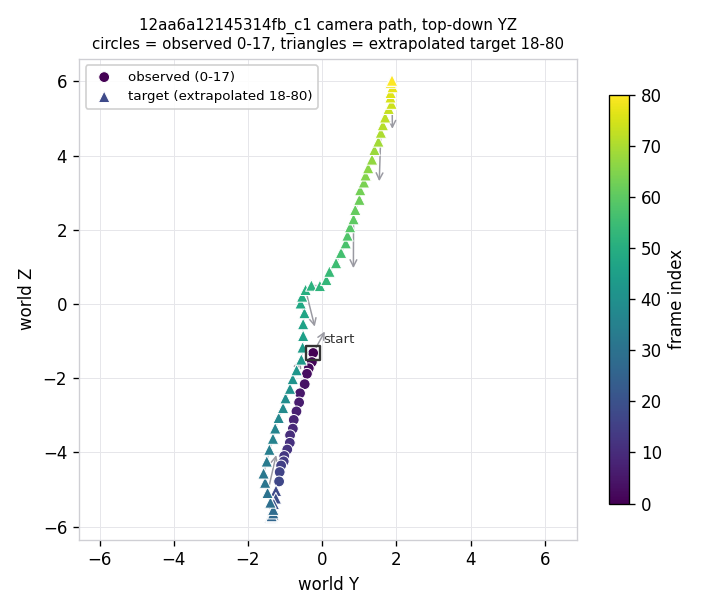
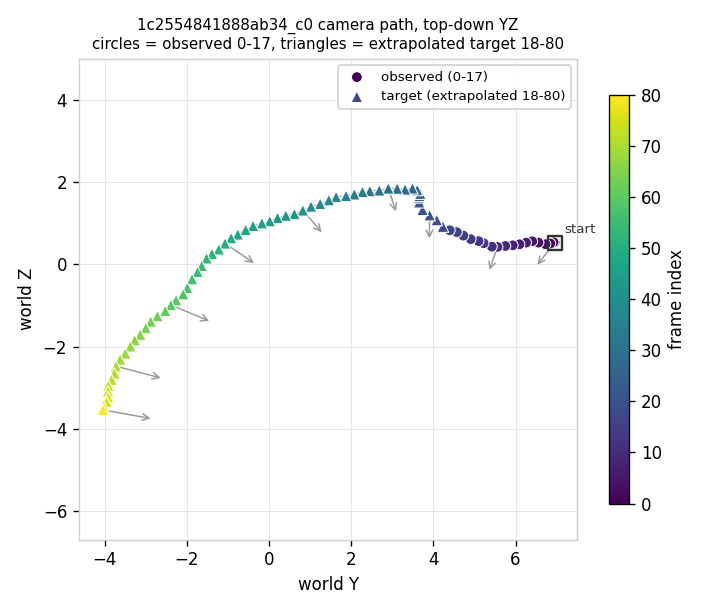
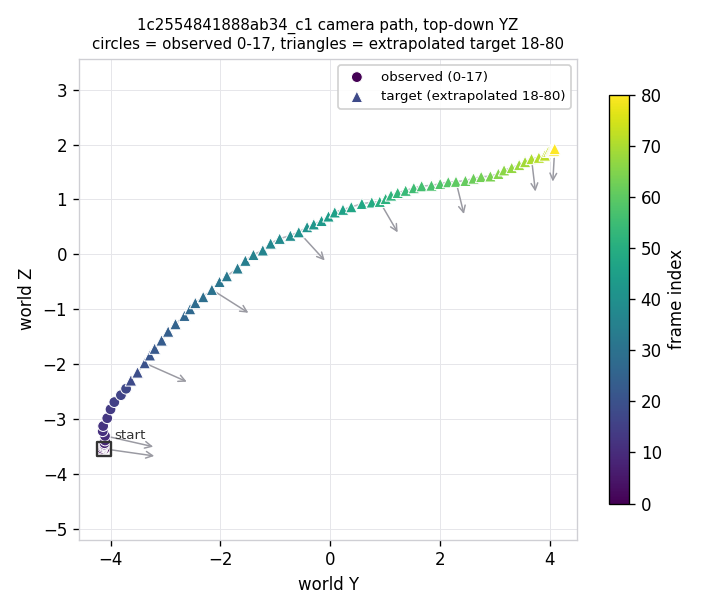
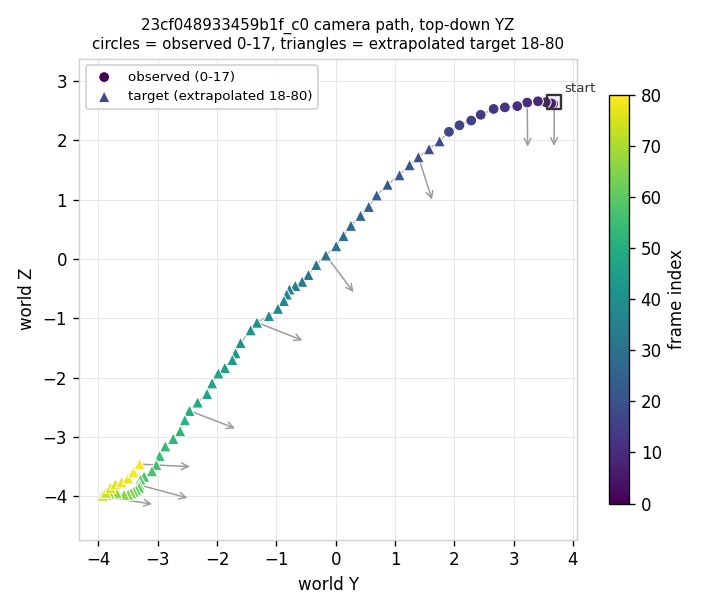
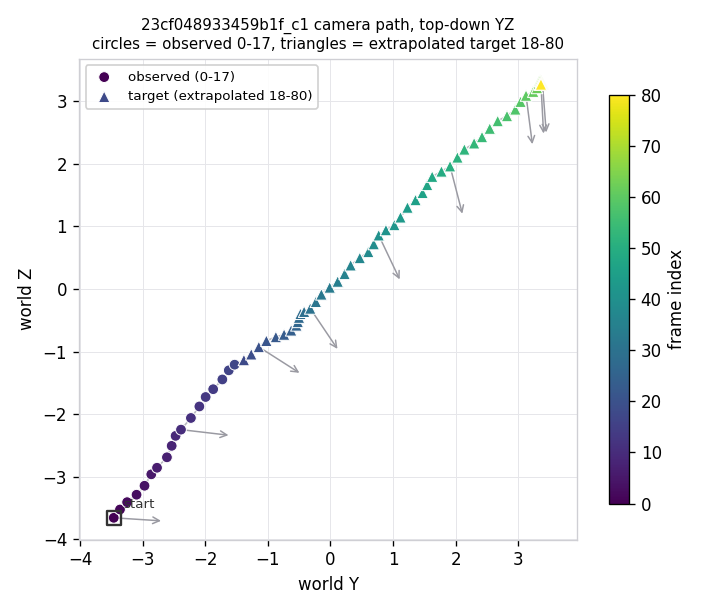
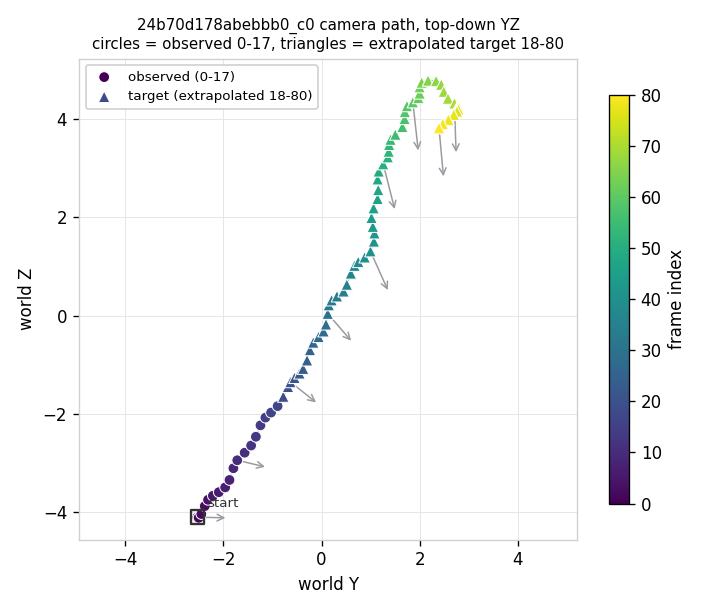
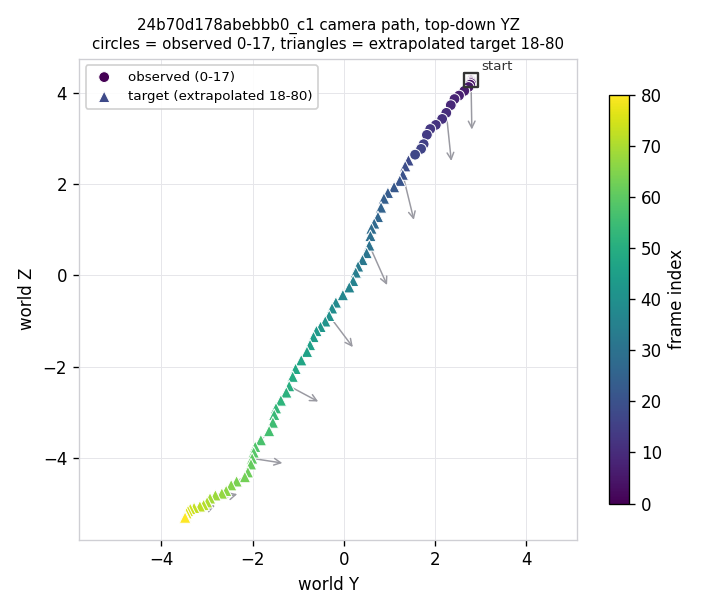
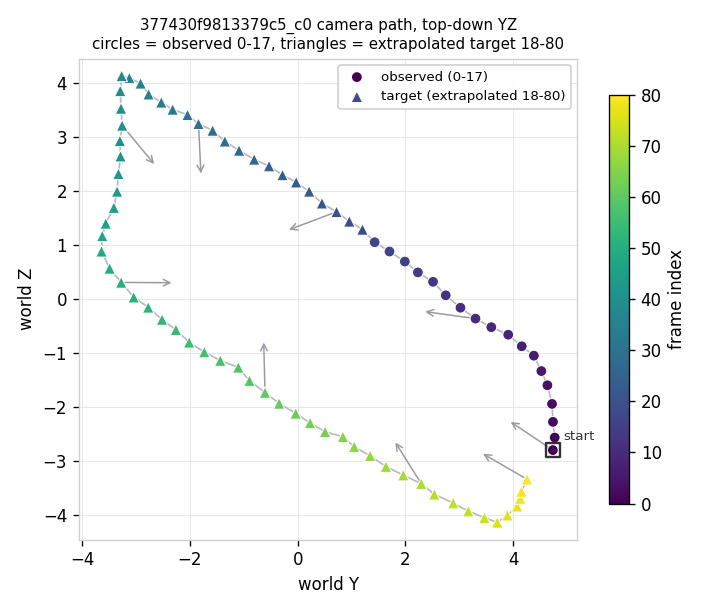
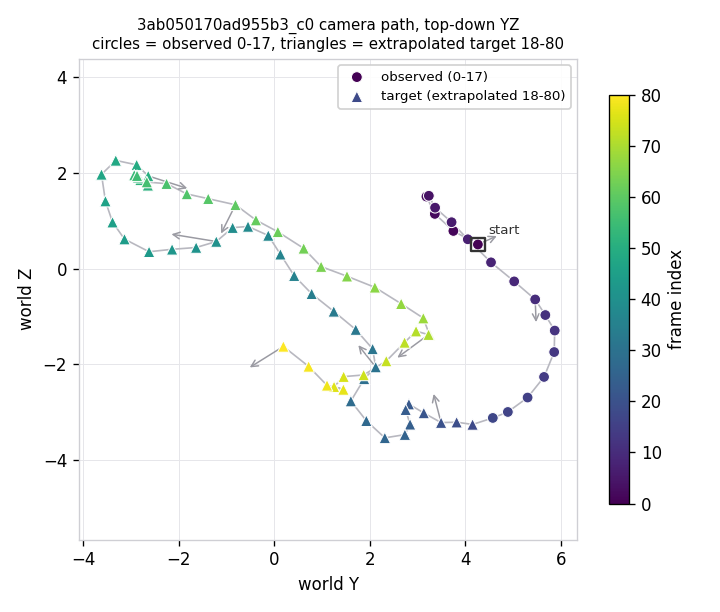
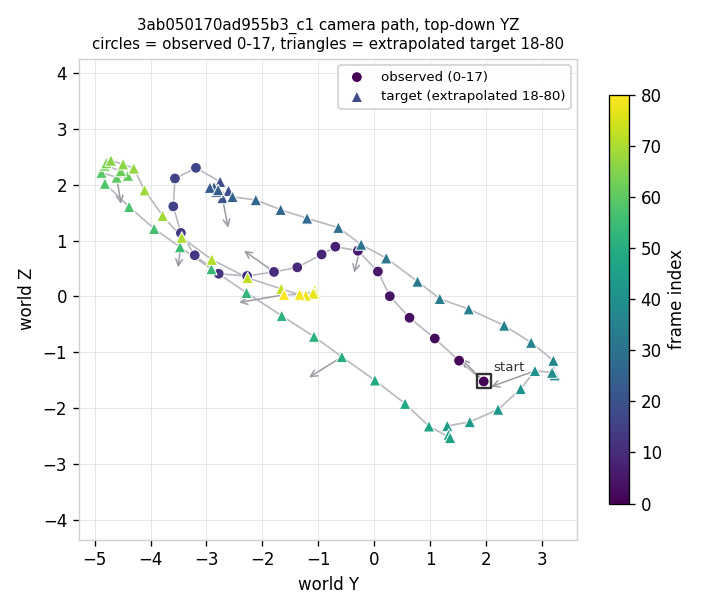
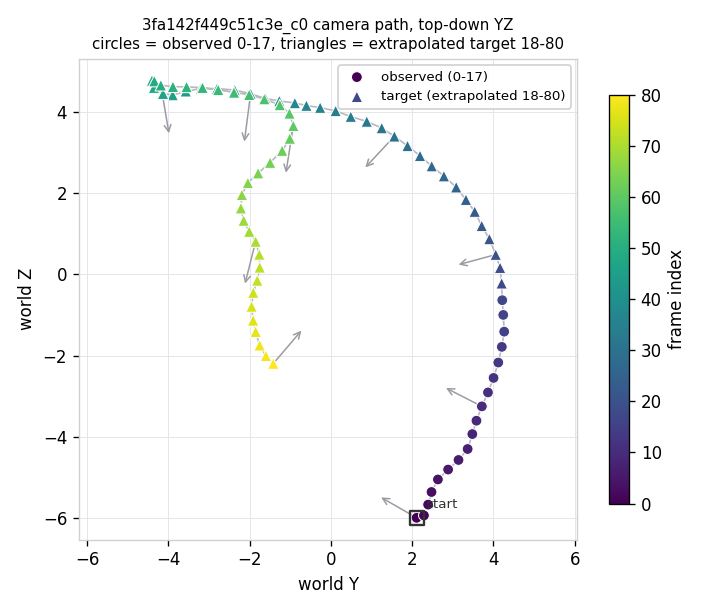
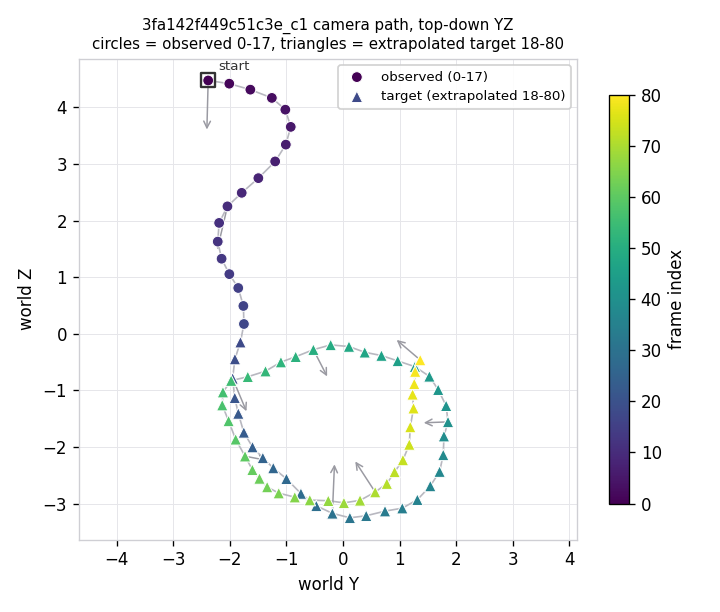
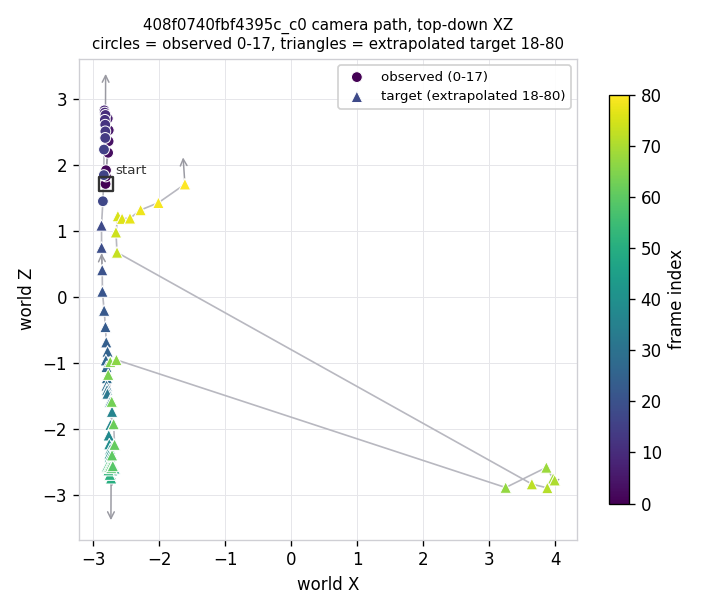
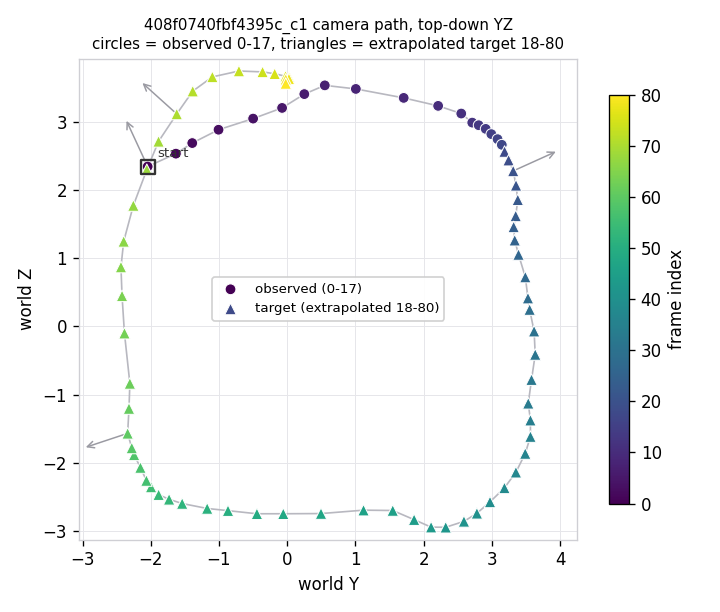
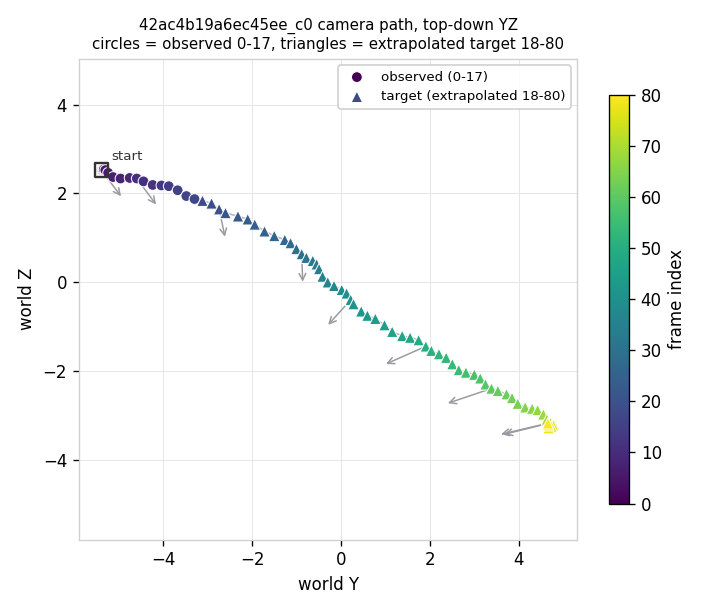
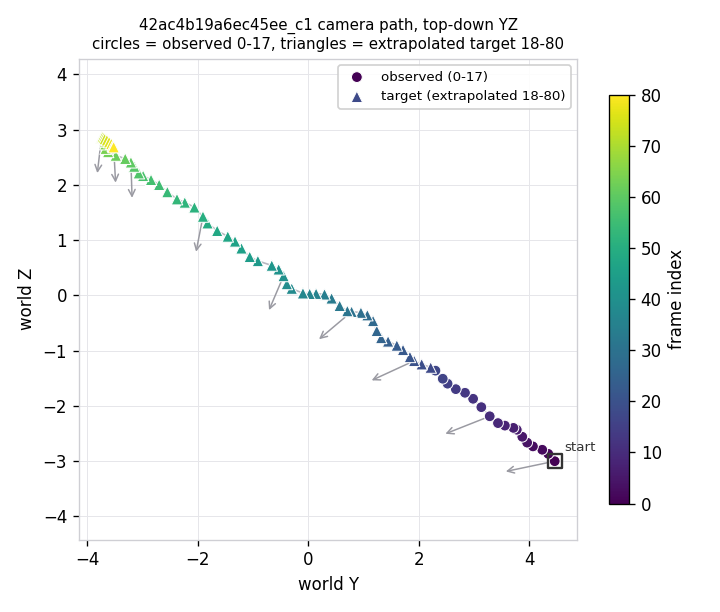
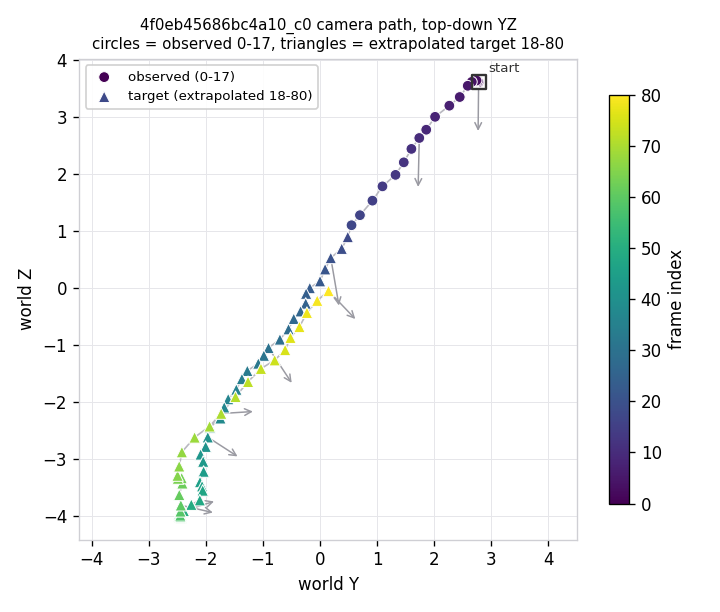
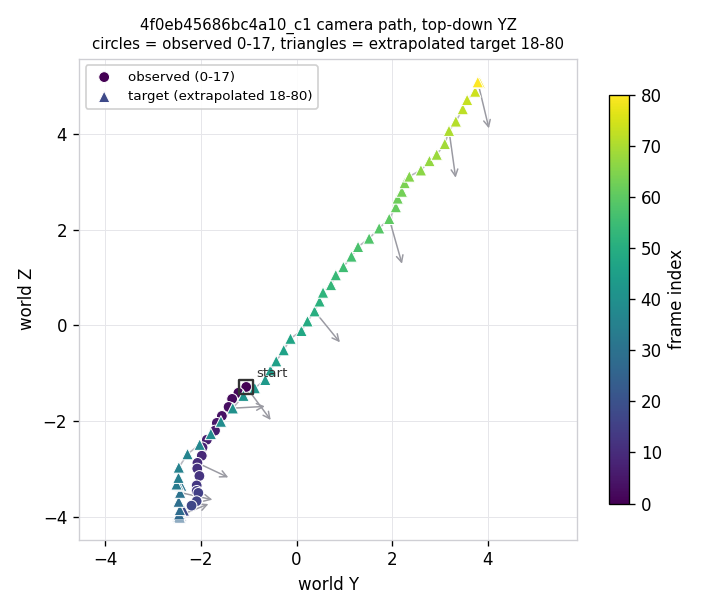
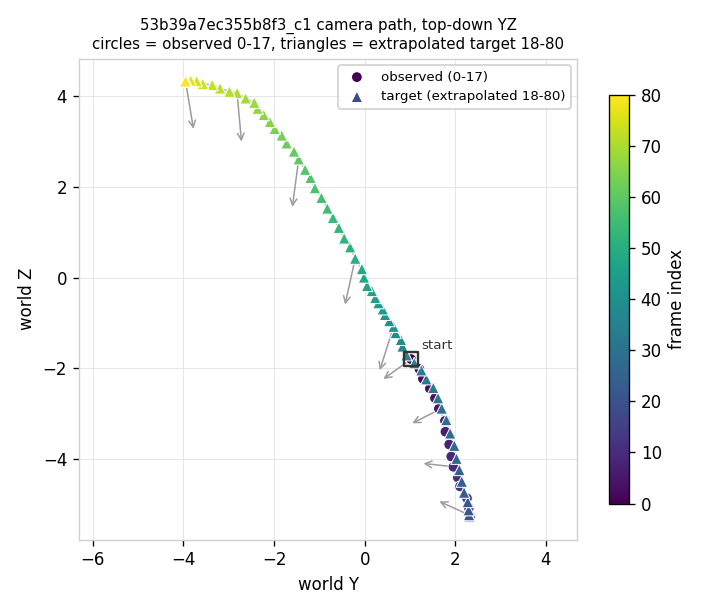
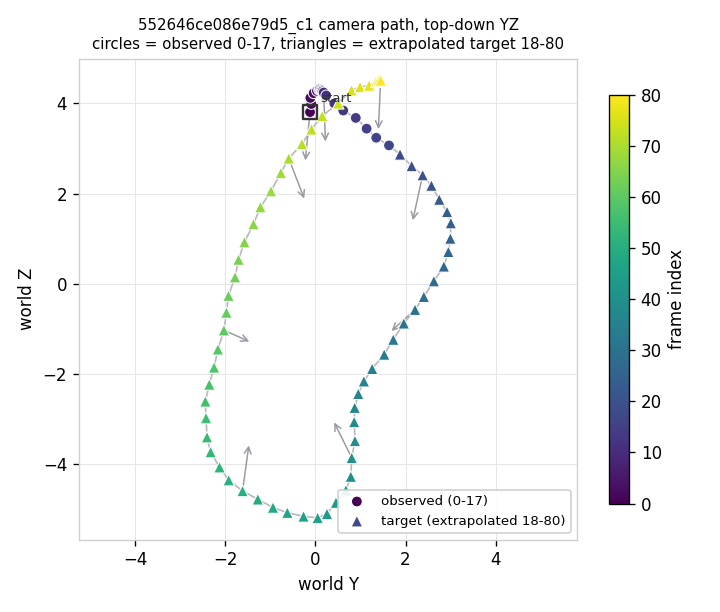
Observe the first 18 frames of a real DL3DV walkthrough with known camera poses,
then generate the continuation along the ground-truth trajectory (frames 18-80, 63 extrapolation
frames) into partially-unseen regions. All methods run the identical protocol; metrics are scored on
the extrapolated region only.
PSNR/SSIM/LPIPS over the extrapolated region; FID = generation realism; TSED = 2-view
SfM inlier fraction; MEt3R = multi-view consistency. Raw PSNR is low because this is generation,
not reconstruction. LagerNVS leads PSNR/SSIM/TSED (see its training-overlap caveat below);
FrameCrafter leads LPIPS & FID; NVS-Solver leads MEt3R. MCSDF
is our method at a pre-retrain checkpoint (a new-objective model is training; this row refreshes when it lands).
LagerNVS note (2026-08-26). Feed-forward latent-geometry NVS (VGGT encoder + ViT
renderer, CVPR'26), run posed with the general_512 checkpoint: all 18 context frames as
posed inputs, 63 target views rendered at 512×296 (its training resolution for this aspect ratio;
direct 832×480 rendering scored 0.8 dB lower on the config-selection clip) and Lanczos-upsampled to
832×480. It is the only feed-forward regression method at the top of the table — and it carries a
training-overlap caveat: its general model trains on Re10k + DL3DV, and none of our 12 benchmark
scenes appear in its 140-scene DL3DV test split, so our scenes were most likely part of its training set.
Treat its PSNR/SSIM as an in-distribution upper bound rather than a like-for-like comparison with methods
that never saw these scenes (e.g. LVSM's checkpoint is Re10k-trained). Per-clip spread is 14.8–24.3 dB
— the 23+ dB clips are exactly where training familiarity is most plausible.
CameraAnything audit (2026-07-29). Its last-place PSNR with best-tier MEt3R (0.107) and
worst rotation error (43.8°) is a task-domain result, not a broken adapter - we verified the pose chain at
three levels: (1) code - their pipeline consumes our OpenCV c2w with no inverse/transpose, relativized to observed
frame 0; (2) numerical - independently recomputed Plücker rays match their function to 2.2e-02 max abs
(half-pixel grid offset; a convention flip would be O(1)); (3) behavioral - two mirrored synthetic yaw
trajectories (±40°, no translation) produce cleanly mirrored camera motion in exactly the direction the
matrices dictate, and their own 8 shipped examples all obey their trajectories. The failure mode is that
CameraAnything is trained for refilming (new viewpoints on content that stays visible); once the target view
leaves the observed frustum it has no geometric evidence and invents a plausible different room. Fairness caveat:
translations are similarity-scaled to max‖t‖=2.0 (their training range); doubling to 4.0 on a held-out
clip gained +0.45 dB and increased motion magnitude without fixing the route, so a full rescaled rerun would move
this row to roughly 11.8 - not enough to change the ordering. Panel note: the per-clip comparison grid is
now 4×3 with 11 method panels + GT (LagerNVS added, Lyra-2 restored alongside CameraAnything).
Per-clip comparison - method grid + camera trajectory